Is it Time to Start “Advertising” Again?
If you were asked to recite a handful of famous ad slogans, you would probably have an easy time rattling off at least three or four of them. And when you did, you would probably also recall the overall look and feel of the brand attached to those slogans. You might even feel a certain emotion associated with each one.
Now, if you were asked to recall the most recent influencer story you watched on Instagram or TikTok or wherever you run into this kind of content, the chances are probably good that you couldn’t recall anything that was said. Maybe you could recall what brand the influencer was peddling, but I would bet that the content of their post was quickly forgotten, blending in with everything else you saw during your scrolling session.
That’s because we are completely inundated with content to the point that we are becoming numb to the majority of it. Some of this content is from our friends, some from creators simply doing what they enjoy, and a heck of a lot from paid content creators like influencers. We are flooded with messaging during the shows we watch, the emails we receive, unsolicited “friend” requests on social media, push notifications… it is impossible to engage with any form of media or communication without someone trying to sell us something. And more often than not, these sales pitches arrive in the form of some kind of story of influence. It can be exhausting. And, frankly, doesn’t 99% of it feel wholly insincere? Are you beginning to feel more like a mark, and less like a valued customer?
Recent research from BBB National Programs, as reported by this piece from Net Influencer, found that a trust deficit exists between more traditional advertising and influencer content marketing. It showed that 87% of consumers express trust in advertising generally (with 5.5% trusting completely and 83.2% somewhat), while only 74% trust influencer content (5% completely, 69% somewhat). In addition, the research revealed that 26% of consumers do not trust influencers at all, more than double the 11.3% who distrust advertising generally.
Perhaps then, it’s time to reboot the traditional ad?
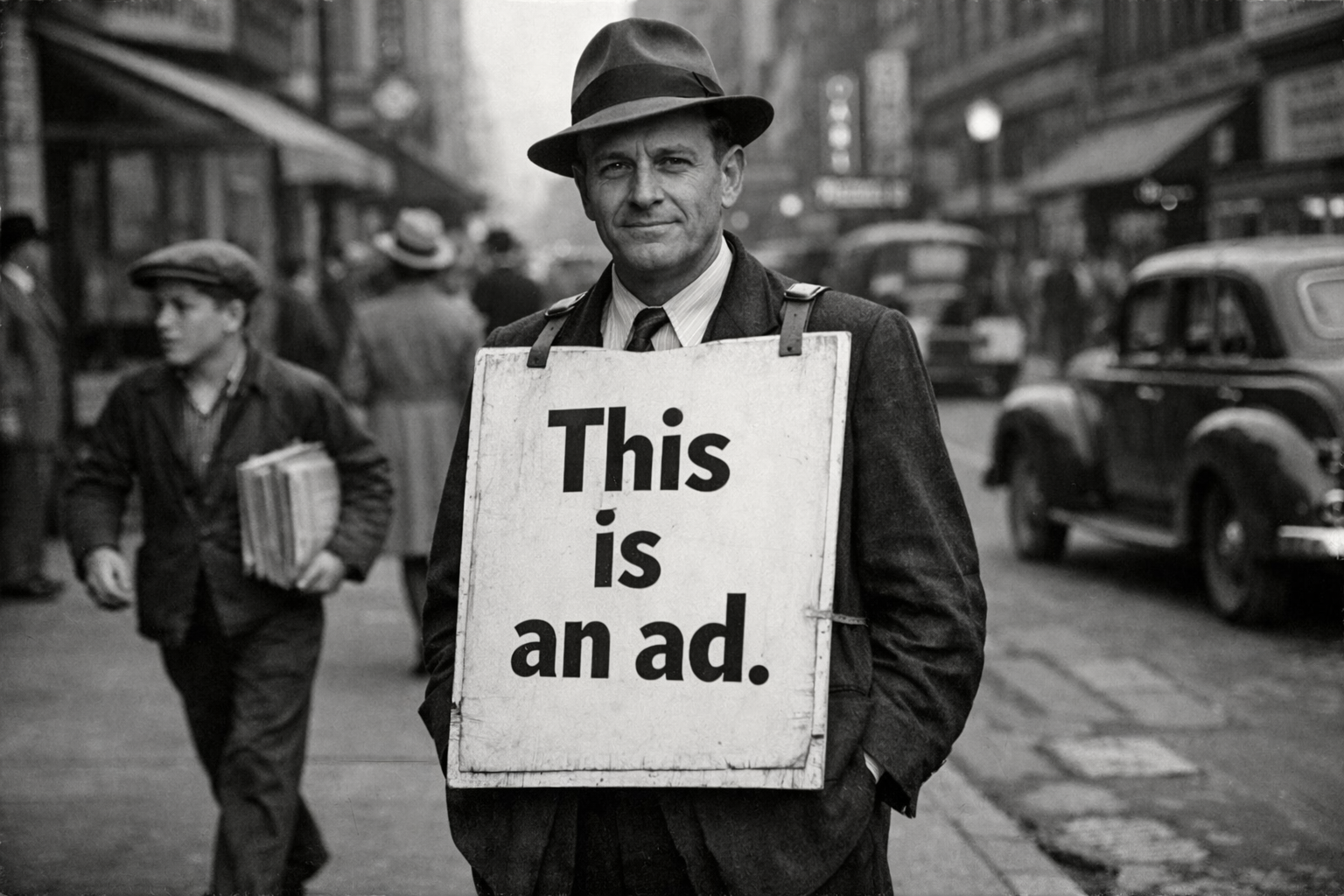
And I don’t necessarily mean sandwich boards and billboards but one striking visual, one simple message, straight from the horse’s mouth.
The thing about more “traditional” advertising is that we all understand–and accept–that we are being advertised to. We know full well that the intent of the message is to sell us something. It doesn’t approach us in disguise.
I’ve watched plenty of influencer content. It’s impossible to avoid. I’ve even considered buying what an influencer is selling me. But then, I pause. I get a kind of icky feeling that I’m being manipulated. This person is desperately trying to make me feel a certain way, sometimes even trying to make me believe they care about me as a friend, so that I’ll buy and they and the brand get paid.
On the other hand, when I see an ad, a straight up ad, I consider it in a totally different light. I am more open-minded because I know exactly what is going on. The brand has a product, I have money. They want the money, and maybe I want the product? Pretty simple. Very straightforward. Very honest. (We can argue about the ‘honesty’ of advertising and it’s a solid debate. But the pitch itself is quite transparent.)
Influencers are here to stay. (Really, they are just an evolution of the spokesperson, but with a much deeper psychological twist.) And it’s totally understandable. Influencers have proven to have a huge impact on sales and brand visibility. But as time goes on, and we keep getting pounded with influence, and AI gets better at blurring the lines between what is real and what is generated, brands might want to consider a stronger push into more “traditional” advertising.
Tell me what you want to say. Say it to my face. I trust that you’re going to say what you really mean. And for that, I’ll honestly consider it.
Thinking about it? We love a good ad campaign. If we can interest you in that, let’s talk.
(Yes, I did create that image with AI. It is not real. I am trying to sell you an idea. The content, however, is 100% human generated.